
Anthi Chanda, Chowka Bara, Ashta Chamma: Regional Names
The Chowka Bara game is known by different names across India — Anthi Chanda, Ashta Chamma, Daayam, and more. Here is every regional variant explained.
 Saathi Games Team
In this article
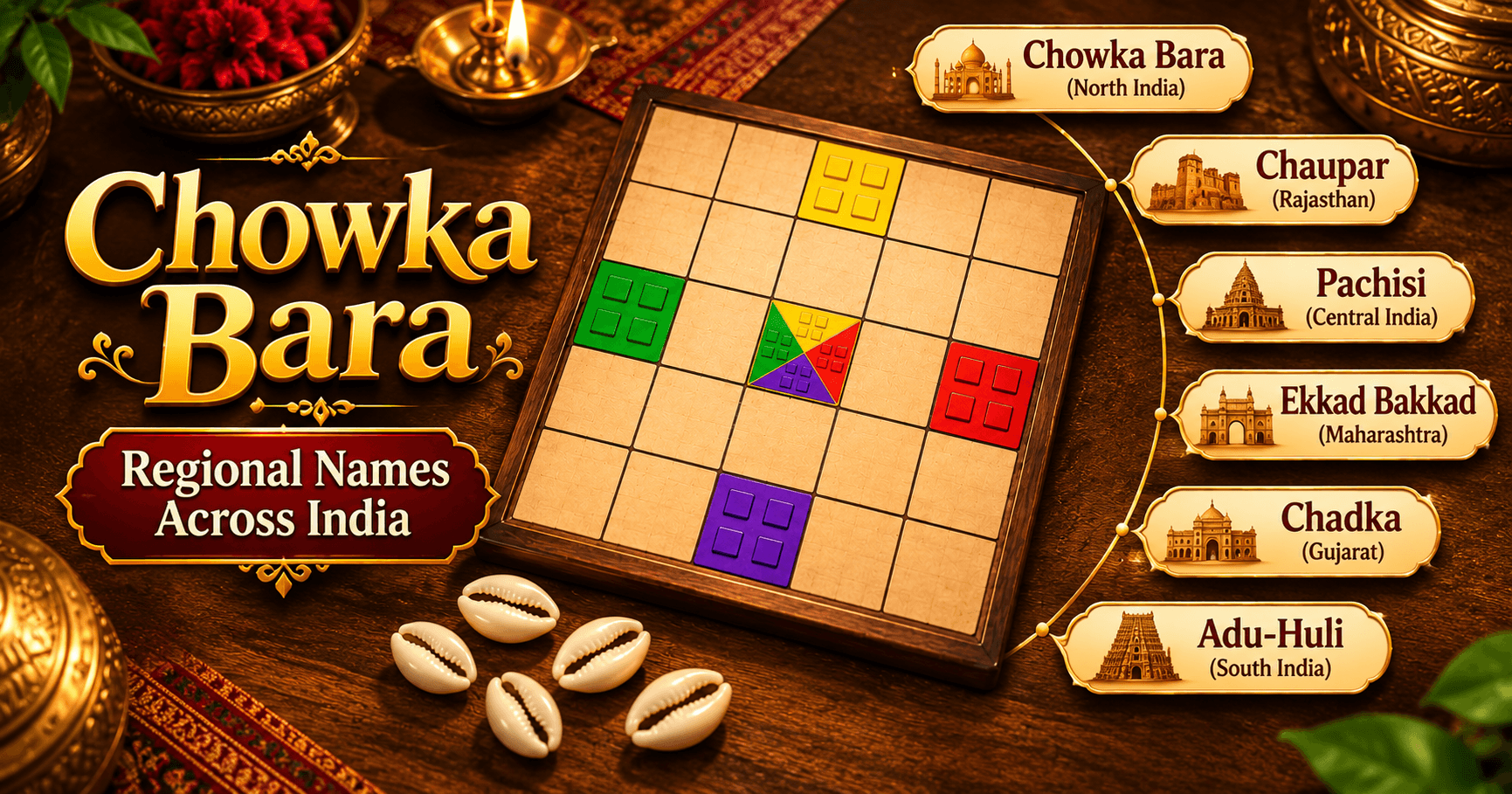
The game has been played for centuries across India, but ask for it by name and you will get a different answer in every state. In Karnataka it is Chowka Bara. In Andhra Pradesh and Telangana it is Ashta Chamma. In Tamil Nadu you will hear Daayam or Thaayam. In Maharashtra they call it Ashta Kashte. In Kerala it goes by Kavidi Kali.
They are all the same game at heart: four cowrie shells, a 5×5 board, four pawns per player, and a race to the centre. The Anthi Chanda app for Android, published by Saathi Games, brings every version to your phone under one name. This post maps out the regional names, the small differences between versions, and why this game refuses to disappear.
If you are looking for the full rules, see our step-by-step guide to playing Anthi Chanda.
One Game, Many Names
The cowrie shell board game belongs to the Pachisi family, a group of cross-and-circle race games that originated in India. Pachisi itself is played on a cross-shaped board, but somewhere along the way a simpler cousin emerged: a square 5×5 grid, fewer pawns, and cowrie shells instead of long dice.
That simpler cousin spread across southern and western India, picking up a local name in every region it reached. Here are the main ones.
Chowka Bara — Karnataka
Chowka Bara (also spelled Chowka Bhara or Chauka Bara) is the most widely searched name for the game online. "Chowka" refers to the 5×5 square board, and "Bara" means twelve, a nod to the total number of squares each pawn must cross on the outer ring.
In Karnataka the game is a staple of family gatherings, temple festivals, and long summer afternoons. Older players still use tamarind seeds as pawns and real cowrie shells on a cloth board drawn with chalk.
Ashta Chamma — Andhra Pradesh and Telangana
In Telugu-speaking states the game is Ashta Chamma. "Ashta" means eight, referring to the eight-step bonus move you get when all four cowrie shells land face down. "Chamma" comes from the word for the shell throw.
The rules are nearly identical to Chowka Bara, but a few families in Telangana play with a slight variation: the bonus throw for cutting an opponent is optional, not mandatory. In the standard version, and in the Anthi Chanda app, the bonus throw is always given.
Daayam and Thaayam — Tamil Nadu
Tamil Nadu has two common names for the game. Daayam refers to the cowrie shell throw itself, while Thaayam is an older word for the same concept. Both names put the focus on the central mechanic: tossing shells and reading how they land.
Some Tamil families play on a larger grid or with different starting positions, but the 5×5 board with four pawns per player remains the most popular version and the one available in the app.
Ashta Kashte — Maharashtra
In Marathi the game is Ashta Kashte, meaning "eight difficulties" or "eight troubles." The name captures the frustration of needing an exact roll to finish: your pawn sits one square from the centre and you keep throwing twos and threes.
Ashta Kashte follows the same core rules. A small regional difference is that some Maharashtrian families allow pawns to start only after a Chanda throw (all four shells face up), adding an extra layer of luck at the beginning.
Kavidi Kali — Kerala
In Malayalam the game is Kavidi Kali. "Kavidi" refers to the cowrie shell, and "Kali" simply means game. It is a direct, no-frills name: the cowrie shell game.
Kerala players sometimes use six cowrie shells instead of four, which changes the range of possible moves. The Anthi Chanda app uses the more common four-shell version, keeping the game consistent across regions.
Other Names
You may also encounter:
- Pagade — used in parts of northern Karnataka
- Champa — an older name heard in rural Andhra Pradesh
- Katte Mane — literally "building game" in some Kannada dialects, referring to the board itself
The boundaries between names are not sharp. Families who moved from Karnataka to Tamil Nadu might still call it Chowka Bara, and a Hyderabadi player might use Ashta Chamma and Chowka Bara interchangeably. The game does not care what you call it.
What Changes Between Regions
The differences are small, but they exist. Here is a quick comparison:
| Region | Name | Shells | Starting rule | Bonus throw on cut |
|---|---|---|---|---|
| Karnataka | Chowka Bara | 4 | Pawns start immediately | Yes |
| Andhra/Telangana | Ashta Chamma | 4 | Pawns start immediately | Usually yes |
| Tamil Nadu | Daayam / Thaayam | 4 | Pawns start immediately | Yes |
| Maharashtra | Ashta Kashte | 4 | Some families require Chanda to start | Yes |
| Kerala | Kavidi Kali | 4 or 6 | Varies | Yes |
The core rules — the 5×5 board, the race to the centre, the Chanda (4) and Anthi (8) bonus throws, cutting lone opponents, protected pairs — are the same everywhere.
Why Has This Game Survived?
Board games disappear all the time. New ones launch every year and most are forgotten within a decade. This cowrie shell game has lasted centuries for a few specific reasons.
No equipment needed. The board is a grid you can draw on any flat surface. Pawns can be seeds, pebbles, or torn bits of paper. Cowrie shells were once currency and are still easy to find. You need nothing manufactured to play.
It takes five minutes to learn. There are no complex card interactions, no rulebooks to read, no setup phase. Throw the shells, count the faces, move your pawn. A child can learn by watching a single round.
Every game feels different. The cowrie shells introduce enough randomness that no two games play the same way, but there is real strategy in which pawn to move, when to form pairs, and when to chase an opponent. It sits in a sweet spot between luck and skill that keeps both new and experienced players interested.
It is social. The game is designed for 2 or 4 players sitting together. The cowrie throw is physical and satisfying. There is trash talk when someone gets cut and sent back to start. It fills the same role that card games and board games fill in other cultures: a reason to sit together and compete without screens.
For a deeper look at how this game compares to its most famous descendant, see our post on Anthi Chanda vs Ludo.
Playing All Versions in One App
The Anthi Chanda app uses the most widely accepted rules: four cowrie shells, four pawns per player, all pawns starting immediately, bonus throws on Chanda, Anthi, and cuts. Whether you grew up calling it Chowka Bara, Ashta Chamma, Daayam, or Kavidi Kali, the game will feel familiar.
The app offers three modes:
- Pass and Play — hand the phone to the next player, just like passing the cowrie shells at home
- VS Computer — play against an AI opponent when no one else is around
- 2v2 Team Battle — four players, two teams, played online or on one device
You can play fully offline, so it works during travel, in areas with poor connectivity, or simply when you want to put the Wi-Fi down for a while.
What to Read Next
- Anthi Chanda rules: how to play, strategy and tips — the full rules guide
- Anthi Chanda vs Ludo — how the two Pachisi descendants compare
- Download Anthi Chanda for Android — free on Google Play