XO Game, Tic Tac Toe, or Noughts and Crosses: Why So Many Names?
The xo game has a dozen names across the world. This guide traces its history from ancient origins to modern apps and explains every regional variation.
 Saathi Games Team
In this article
The xo game is one of the oldest strategy games in the world, and its many names tell a story about how cultures independently discovered the same pattern.
You know the game: a 3x3 grid, two players, one marks X and the other marks O, first to get three in a row wins. It is one of the most recognized games on the planet. And yet it has no single agreed-upon name. Why?
The Many Names
Here is a partial list of what this game is called around the world:
- Tic Tac Toe — United States, Canada
- Noughts and Crosses — United Kingdom, Australia, New Zealand, South Africa
- XO or X and O — India, Middle East, parts of Africa
- OXO — Parts of the UK
- Tris — Italy
- Tres en raya (Three in a row) — Spain and Latin America
- Morpion — France
- Boter, kaas en eieren (Butter, cheese, and eggs) — Netherlands
- Jogo da velha (Old lady's game) — Brazil
The variety is a clue to how old the game is. When something has been independently named in dozens of languages across centuries, you know it predates any unified source.
Ancient Origins
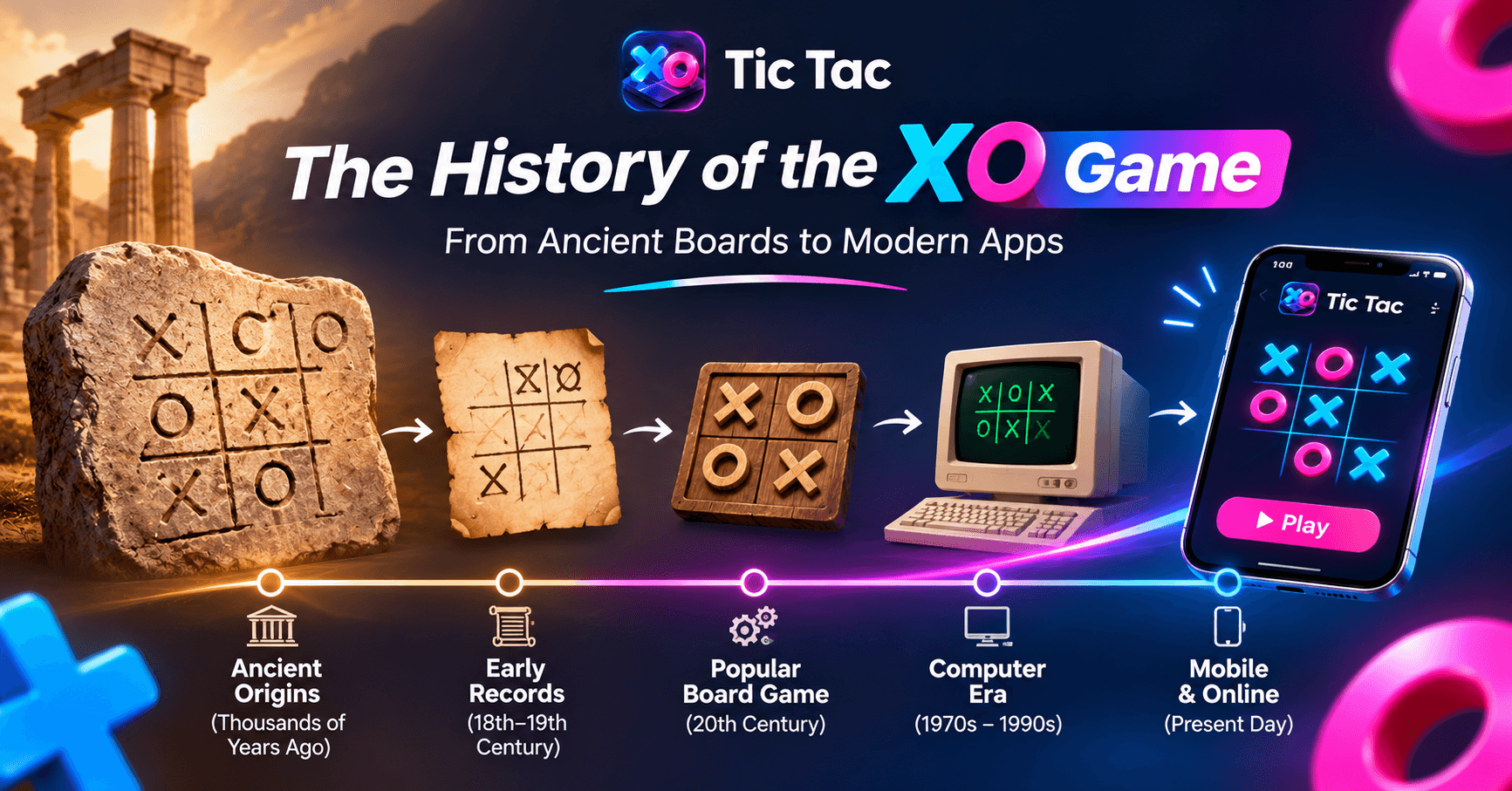
The earliest surviving evidence of a tic-tac-toe-style game is carved into stone at Kurna in Egypt, dated to approximately 1300 BCE. The carvings show a grid with marks in it — not definitively the same game, but the structural pattern matches.
In ancient Rome, a very similar game called Terni Lapilli (three stones) was played by children and soldiers. Grid patterns matching the game have been found carved into stone surfaces throughout the Roman Empire, including the Forum in Rome and Roman military sites in Britain. The Roman version used three small stones instead of drawn marks — each player moved their stones around the grid, which makes it slightly different from the modern version but unmistakably related.
How the Modern Rules Developed
The current version — where you draw X or O on the grid and do not move pieces — appears clearly in English documents from the 1800s. The name "Noughts and Crosses" appears in print as early as 1858 in England. "Noughts" means zeros (the O), "crosses" means the X.
The American name "Tic Tac Toe" has a murkier origin. The phrase "Tic Tac Toe" appears in American sources from the late 1800s as a name for a children's slate-pencil game (different from this game), and the name seems to have shifted to the X and O game by the early 1900s. The most plausible explanation is that the sound of drawing lines on a slate or chalk board sounded like "tic tac toe."
How It Became "XO" in India
In India and the Middle East, the game is widely called "XO" or "X and O" — simply naming the marks rather than the game concept. This naming convention likely spread through British colonial education, where the game was taught but the British name "Noughts and Crosses" was simplified to just the marks themselves in the local adoption.
In South Indian schools, "X and O" was the common name for generations. Today "XO" dominates informal use, while "Tic Tac Toe" appears in app stores and educational contexts.
The TicTac App
TicTac by Saathi Games is named after the global shorthand for the game — and it is exactly what you expect: classic Tic Tac Toe, playable against an AI or against friends, with skill-based earning features. If you want to understand the perfect strategy, read the guide on Tic Tac Toe as a solved game.
Why One Game, So Many Names?
The consistent pattern is local naming. Each culture that encountered the game named it based on what they noticed most: the marks (XO), the winning condition (Tres en raya = three in a row), the sound (Tic Tac Toe), the objects used (Noughts and Crosses), or a cultural association (Jogo da Velha = Old Lady's Game in Brazil, possibly because grandmothers played it).
None of these names is more correct than another. They all describe the same game that children have been drawing on available surfaces for at least 3,000 years.
Disclosure: TicTac is developed by Saathi Games, which runs this blog.
XO Game: Frequently Asked Questions
Where did the xo game originally come from? The exact origin of the xo game is debated, but evidence of similar games appears in ancient Egypt around 1300 BCE and in Roman ruins as terni lapilli. Whether these were true xo game ancestors or similar games that evolved independently is unclear. The modern xo game with its current rules became standardised in Britain during the 19th century as noughts and crosses.
Why is the xo game called tic tac toe in the United States? The term tic tac toe for the xo game became common in the United States in the early 20th century. Some theories link it to a children's counting rhyme, others to earlier slate board games. The name spread through American schoolchildren and eventually replaced older terms. Today tic tac toe is the standard name for the xo game in North America, while noughts and crosses remains the standard in Britain.
Why is the xo game popular despite being a solved game? The xo game remains popular because it is accessible, fast, and social. The solved nature of the xo game only matters at high skill levels. For most casual players, especially children, the xo game still feels open and unpredictable. The xo game also requires no equipment beyond paper and a pen, making it universally available.
How many names does the xo game have? The xo game has at least a dozen widely used names. In Britain it is noughts and crosses. In the US it is tic tac toe. In India it is commonly called xo game or X-O. In France it is morpion. In the Czech Republic it is pipsa. Each culture that encountered the xo game gave it a name from local language or tradition, which is why the same game has so many identities.
Is TicTac the same as the xo game? TicTac by Saathi Games is a mobile version of the xo game with multiple difficulty levels and pass-and-play multiplayer. The rules are identical to the xo game. TicTac adds a Hard AI mode that plays the perfect xo game strategy, making it unbeatable. For casual players, TicTac is a clean, free version of the xo game available on Android.